Thoughts on the October 2nd One Nation Working Together Rally
For quite some time, activists in the labor movement have been urging the AFL-CIO leadership to organize a Solidarity Day III rally as a way of fighting back against the attacks on working people and to counter the mobilizations of the right-wing. My own labor council, the Troy Area Labor Council, sent such a request to the national AFL-CIO leadership, urging them to call a national demonstration around the demands of Jobs, Peace and Healthcare. Our resolution was picked up by other labor councils from around the country, and a number of such resolutions were adopted by various labor bodies.
So we were thrilled when we heard that 1199 SEIU and the NAACP were organizing such a rally and that the AFL-CIO was joining the effort. We were sure that this combination between the unions and the largest civil rights organization in the country would attract hundreds of thousands to Washington, maybe more than a million. The reality of this event, unfortunately, fell far short of what it could have been, both in numbers and in political content.
Although it is always great when unions and civil rights organizations call people out to the streets to demonstrate, I found the rally disappointing. In working to build the demonstration, I found that the AFL-CIO seemed to be supporting it only half heartedly. I heard comments to the effect that the day could have been better spent going door-to-door for the candidates.
The politics were also not clear. There was resistance to including peace in the call, and there was a clear absence of any demands on the government. The One Nation Working Together web site had the generic slogans of “good jobs, equal justice, and quality public education.” Of course, we are all for these things but just cheerleading while making no specific demands around which to mobilize people will get us nowhere.
The turnout--somewhere between 100,000 – 150,000—also was disappointing. The organizers claimed that 170,000 people came. Commentators, like the Associated Press, said there were fewer people than those who’d shown up at the Glen Beck rally in August. Glen Beck had the audacity to hold a rally on the same day and at the very spot where Martin Luther King gave his “I have a dream” speech. Glen Beck rallied in opposition to everything that Martin Luther King fought for. King was a champion for civil rights, labor rights, and peace; Beck represents hatred, prejudice, and war. But the labor movement and the left were unable to effectively oppose him, which shows how very weak both are.
Labor is under attack: union membership has dropped to less than 14% in the US; for the private sector, it is below 8%. The so-called economic crisis has allowed the government to attack the public employee unions that were always considered secure. So teachers as well as municipal, state, and federal workers are all under attack. There are layoffs, furloughs, and changes to retirement and healthcare benefits being demanded as private contractors are taking union jobs. This is happening under Republicans as well as Democrats, such as the state government of New York, where I live. It is only through mobilization of the working people that we will be able to stave off these attacks. The October 2nd rally did nothing to point us in this direction.
The national leadership of the labor movement can see only one way forward, which is through the vehicle of the Democratic Party. However, this is not how labor won earlier gains such as the right to organize and collective bargaining. It did so through mobilization, strikes, sit-downs, and even general strikes and organized defense against goon squads. All that we were told at the Oct. 2nd rally was to get out the vote for the Democrats. Yet, for the last two years the Democrats have controlled both houses of congress and the executive branch. Therefore, to make demands of the government means making demands on the Democrats, this could hurt their chances in November. So there were no demands, thereby sacrificing a great opportunity for us for the sake of the Democrats, who have done nothing on our behalf.
In New York State we have a $9 billion deficit while New York’s contribution for the wars for this fiscal year will be $15 billion. Yet not one Democrat, Republican, or major labor leader dares to point out this glaring contradiction.
Despite the rally’s shortcomings, the peace movement had an important presence. We organized peace rallies and than marched as a contingent to the main rally. This along with the distribution of signs and literature gave an antiwar presence at the rally. This is very important, because during this period of neo-liberal globalization, as jobs and investment go overseas our economy will require continued war to protect US corporate interests abroad. This is why it is essential to connect the issues of jobs and the wars.
Some hoped that the October 2nd mobilization would lead to an ongoing coalition between labor, peace activists, and the communities under attack. The only convergence that can come out of this rally is a convergence around electing more democrats, which will not further the fight for jobs or peace. Instead, we need to build movements that are independent of either party and our unions need to learn to rely on the strength of their own membership and allies.
Thursday, October 14, 2010


Friday, August 6, 2010
Report on the National Peace Conference

Below is a report I sent to the various Albany, NY area listservs on the United National Antiwar Conference that took place in Albany on July 23 - 25.
The United National Peace Conference in Albany brought together people from around the country and overseas. Although two people from India were denied visas to come to the conference, 520 pre-registered and 256 additional people registered at the door, for a total of 776 participants.
The Sanctuary for Independent Media provided live-streaming of major segments of the conference to the Internet, provided a place for people to upload pictures and tweets and posted major presentations on Youtube. The day after the conference, the Youtube videos got over 17,000 hits, making them the most viewed videos from a non-profit organization for that day. This enabled thousands who could not physically make it to the conference to nonetheless experience it.
The core leaders of the anti-war movement were all there, including Media Benjamin, Col. Ann Wright, Kathy Kelly, Dahlia Wasfi, Michael McPherson from UFPJ and VFP, Kevin Martin from Peace Action, Blasé Bonpane, Mark Johnson from Fellowship of Reconciliation, Glen Ford from Black Agenda Report and Black is Back, Kevin Zeese, Fahima Vorgetts, Mike Ferner, Michael Eisencher from US Labor Against the War, Larry Holmes from the International Action Center, Nada Khader, Debra Sweet, Leila Zand, and others. Cindy Sheehan also came but had to leave immediately when her daughter went into labor back in California. Additionally, Ethan McCord, a former soldier on the ground in Iraq who was seen on the first leaked Wikileaks video, spoke out publicly for the first time. War resisters, GIs who have refused to deploy, skyped into the conference from Canada, since they could not be there in person.
Leaders of other movements were also at the conference; these include leaders of the Labor movement, such as Donna Dewitt, President of the South Carolina AFL-CIO,. Leaders of SEIU/1199 came to ask the peace movement to support their upcoming October 2nd, 2010 march on Washington. The conference was welcomed by Mike Keenan, president of the Troy Area Labor Council. Present were Margaret Flowers and other leaders of the single payer movement, as well as Lynda Cruz, Teresa Gutierrez, and other leaders of the immigrant’s rights movement. Palestinian rights activists played a big role in the conference, as did leaders of the movement against intervention in Iran, Columbia, Honduras, and Haiti. Leaders of the environmental movement were present as were leaders of the Muslim solidarity movement and student leaders like Blanca Missa, one of the central leaders of the recent student protests on the Berkeley campus against California’s cuts to education. Dr. Margaret Flowers, a central leader of the movement for single payer healthcare led a workshop with other healthcare advocates and spoke at the press conference that preceded the conference at which she made a strong connection between the movement for universal healthcare and peace.
Noam Chomsky spoke Saturday morning via video. Following by another keynote address given by Donna Dewitt, President of the South Carolina AFL-CIO, and leading member or the National Assembly and US Labor Against the War. We listened to Mumia Abu-Jamal’s audio taped message to the conference from death row and to the narration of Imam Aref’s, one of the wrongly prosecuted Muslims from Albany from his prison cell. Ralph Poynter, husband of imprisoned civil rights attorney Lynne Stewart, read her message to those assembled. Lynne was a member of the administrative body of the National Assembly to End US Wars and Occupations, the group that had initiated the conference. She was also a founding member of Project Salam, one of the other 31 co-sponsoring groups.
During panels held on Friday night and Saturday, movement leaders discussed the future direction of the anti-war movement. Throughout the weekend, the backdrop to the stage and podium was a beautiful 40 foot mural painted by Mike Alewitz and Jerry Butler, who teach art at Central Connecticut State University. Mike was an anti-war leader at Kent State University 40 years ago, during the period when National Guardsmen killed four student anti-war protestors. Jerry was at Jackson State when, 10 days later, police shot and killed students on that campus.
The conference presented thirty-three workshops on topics related to war and social justice. Presenters came from a range of perspectives, faith-based peace groups, immigrant’s rights advocates, the Palestinian rights movement, the labor movement, active duty GIs and veteran’s movements, and many more. The workshops and presenters are listed on the conference web site (http://www.nationalpeaceconference.org).
The conference operated democratically, with every person in attendance having a voice and a vote. Out of this process came an Action Proposal and a set of resolutions. All of this material will be posted in the near future on the national peace conference web site (www.nationalpeaceconference.org). Basically, the Action Proposal calls for local actions in the fall and bi-coastal demonstrations in New York City and California in the spring. The spring actions will be accompanied by separate and distinct non-violent civil disobedience actions. The proposal also calls for support of and collaboration in building the mobilizations being called by the labor and civil rights movements in the coming months. These include demonstration planned for Washington and Detroit on August 28 and a large October 2nd demonstration being organized by SEIU/1199, AFL-CIO, the NAACP, and others. The action proposal includes a strong stand in support of Palestinian rights and against the threats directed at Iran. It calls for coordinated teach-ins, lobbying efforts, and campaigns to pass city, town, and village resolutions on the issue of war spending and its impacts on the economy.
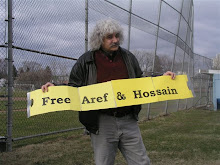
One theme running throughout the conference was the connection between the anti-war movement and the Muslim solidarity movement. Both the wars and the attacks on Muslims are the products of Washington’s phony war on terror. The wars have been called preemptive wars, and the prosecutions of Muslims have been labeled preemptive prosecution. These concepts are used by the government as theoretical justifications for the wars going on at home and abroad. The Muslim solidarity issue was highlighted at a poignant and symbolic march from the peace conference to the Masjid-Al Salam mosque on Central Avenue where the imprisoned Albany Muslims used to worship. At the Mosque, a rally was held where family member and supporters of the wrongly prosecuted Muslims spoke along with leaders of the anti-war movement such as Kathy Kelly, Medea Benjamin and Sara Flounders of the International Action Center. Also, on Saturday, a lunch time presentation was given by Shamshad Ahmad, the president of the mosque. A statement was read by Imam Aref, the former Imam of the Mosque, now in prison for 15 years
Why Albany? Some people have asked why the conference took place in Albany. My answer is that it could not have happened any where else. On the national level, the peace movement has been weak and unable to capitalize on the fact that the majority opposes the wars and the fact that trillions is being spent on war as education, healthcare and other human needs are being cut. Consequently, the National Assembly to End US Wars and Occupations decided to forgo its own national conference in favor of building a unity conference of the entire anti-war movement, understanding that the lack of unity in the US anti-war movement has been a major factor in the weakness of our movement. The Albany area has a strong peace movement in which all of the groups work together. In addition, when Muslims were attacked in our community, the peace movement and eventually the media and large sections of the non-Muslim community stood behind them. In many other areas of the country, this didn’t happen, as some peace groups felt that being associated with the unjustly prosecuted Muslims might alienate them from the politicians and others in the non-Muslim community. But what people in Albany realized is that the wars and the pre-emptive prosecutions of Muslims are two of the faces of the same phony war on terror. So as we took up the fight against the attacks on Muslims and the racism these attacks have engendered, we undercut the war on terror justification for the wars of occupation while, at the same time, finding new allies in the struggle for peace. Building bridges between the Muslim and the non-Muslim communities is exactly the opposite of what the government wanted, with its use of agent provocateurs and fabricated terror plots,
The conference was the right thing to do at the right time; it came to a close literally hours before the explosive Afghan War Diaries were published by Wikileaks and right before Congress voted for additional funding for the perpetual U.S. wars and occupations. The conference gave our movement a powerful voice at a very critical time. It also succeeded in bringing together thirty-one peace groups with diverse perspectives. We brought together the peace movement with leaders of other movements that have mobilized millions in their own right. In doing so, we took a step forward not only for peace but also for human rights and justice in general.
There also were some shortcomings. Outside of some alternative media, the conference was not covered by the national media, in stark contrast to the coverage of the Tea Party convention which, despite having fewer in attendance, was given prime time live coverage by CNN and other outlets. Maureen Aumand who, along with Mary Finneran, organized the media in Albany alerted the New York Times to the conference on several occasions. The Times tried to explain to her why they would not cover the conference, but the real reason it wasn’t covered is because the powers running the corporate media in the US want to build a right-wing, not a progressive, left-wing movement.
In addition, our audience was mostly older and white. Although polls show anti-war sentiment being greatest among youth and African Americans, we haven’t seen a lot of participation in the anti-war movement from these groups, and this was reflected at the conference, as well.
Finally, there were some tests of our unity at the conference, the most significant one being around the issue of Palestine. Important leaders of the Palestinian movement were in attendance, and a caucus was formed by Palestinian rights activists to discuss how best to integrate the Palestinian issues with the broader peace issues. They put together a resolution and an amendment to the Action Proposal on Palestine, which passed by a large majority. However, some felt that the wording was too strong and therefore fought to change it. This was a serious disagreement, and my hope is that it will not cause any deterioration in our unity.
Pulling together a unity conference with thirty-one different groups, each with its own perspective on how to bring about peace, was a real achievement. However, our true test will be in how united we remain as we build future actions to end the wars. Towards this end, the conference passed a proposal for a continuations committee that will be chaired by Jerry Gordon. It will meet for the first time on August 16th, with the goal of continuing our work and broadening it to include other forces at the local and regional levels.
The peace conference came together at just the right time and place. It happened at the same time when other progressive forces (like the labor and civil rights movements) also are mobilizing (on August 28 and October 2). The labor and civil rights leaders who have called these actions may see them in the context of the mid-term election but they come at a time that millions are being victimized by the wars at home and abroad and are looking for a way to fight back. The unity we attained with the conference was significant. If we can continue and broaden this unity with our allies within and outside of the peace movement we can change the world.
Sunday, April 11, 2010
How to Fix the New York State Budget

The following is a letter that appeared in the Albany Times Union newspaper with the exception of the last paragraph on war spending; this they cut. All solutions that are being project by the media and the politicians to fix the state budget are solutions that fall on the backs of working people and the poor such as tuition increases at the State Universities, layoffs of state workers or asking them for give backs or decreasing the amount of school aid. This letter takes a different approach
In the April 1 article “Paterson warns of ‘massive’ state layoffs,” the governor is reported as proposing delaying the 4 percent raise due to state workers. Once again working people are asked to assume the entire burden of a financial crisis that we had no hand in creating. In reality, there is no budget crisis; we are the richest country in the world and can afford a bigger share of the pie for the working people and the poor.
Why not ask the rich to assume a fairer share of the burden? Over the past years, tax rates have been significantly flattened in favor of the rich so they pay a New York State tax rate not that much different than the poorest New Yorkers. Let’s tax the rich.
While an Albany resident pays 8% tax when they buy a shirt, the less than 1% tax on a stock trade is completely rebated to the payer. Let’s tax stock trades.
According to a Government Accountability Office study, 2/3 of corporate taxes are not paid as Corporations seek tax shelters and other gimmicks to avoid paying taxes. Let’s tax the greedy corporations.
While our state claims a budget deficit of 13 to 18 billion dollars, our state’s share for the illegal and immoral wars in Iraq and Afghanistan is over $87 billion. Let’s end the wars.
Anyone of these alternatives can save our schools, save our jobs and save our state, but it seems that all options that don’t put the entire burden on working people and the poor are off the table
References:
2/3 of corporations pay no taxes: http://money.cnn.com/2008/08/12/news/economy/corporate_taxes/
States cost for war spending: http://www.costofwar.com/
Tax on stock trades is rebated to the payer: http://www.ibo.nyc.ny.us/iboreports/stocktransfertax.pdf
Saturday, March 6, 2010
Left/Right dialogue on War

In Albany, the left and the Tea Party folks have been having a dialogue. So far there have been 3 forums, the first on health care the second on climate change and the third on war. Below is my 5 minute opening remarks as part of the panel for the left side of the discussion on war.
Years ago, when I worked against the Vietnam War, the political and economic context of our struggle was very different than it is today. During Vietnam, for example, we had a growth economy; people were able to get jobs; factories were booming. Today, few factories exist in the US. There are few options for young people other than the military. Today, we have an economic draft instead of a real draft as during Vietnam.
Also the cost of today’s wars fall more on the backs of working people and the poor than during Vietnam. Back then, taxes on corporate profits accounted for over 30% of the total tax revenue; today they accounts for less than 8%. Today, nearly 2/3 of all Corporations-- because of tax havens and other tax trickery -- pay no taxes. The tax structure was also much more progressive in the 1960s and 70s with the highest earners paying more of a fair share of the taxes. Today the tax rates have been significantly flattened putting more of a burden on working people and the poor. The disparity between the rich and the poor has increased in the US to the point where today the top 1% is wealthier than the bottom 95%. As the burden of paying for these illegal and immoral wars falls more and more on working people and the poor we see failing state budgets, cuts to social services and deterioration to our country’s infrastructure.
Military expenditures in the US are more than those of all the rest of the countries in the world combined. They account for more than 50% of our present federal budget. Yet, in these hard economic times as people are losing their homes, their healthcare and their jobs, Obama tells us in the state of the Union address that everything will be frozen or cut, except for the military. I think he has his priorities backwards.
The flight of US industry from US shores to find cheaper resources and labor, with no unions, and no environmental or health and safety regulations -- a process known as globalization -- has required new military thinking. To protect US corporate interests abroad we now have our military in over 135 countries with over 800 permanent, foreign military bases. Our now globalized economy will mean permanent war as the US corporate controlled government seeks to protect US corporate interests abroad. As native populations in these countries seek to reclaim their national resources and wealth for the people or their own counties, they will be accused of terrorism and so, as Bush told us, we will have a permanent war on terror. War will be a permanent part of the politics in this country from now on and so the anti-war movement must become a permanent part of politics in opposition to these policies of exploitation and violence.
The war on terror is a fiction. No country can stand against the military might of the US in a battle field as in WWI and WWII. So the wars will be more guerilla warfare with small irregular bands of people seeking to protect their families and communities from US invasions and occupations and foreign corporate exploitation. As the US violently suppresses those who fight back, more anger and resistance will be engendered causing an ever increasing spiral of violence. We will not end terrorism with war we will only end it with peace and collaboration for the good of all. But peace and collaboration stand in stark contrast to the US corporate grab for foreign resources, markets and cheap labor.
The fake war on terror has also justified attacks on our civil liberties at home and abroad. We have seen the continuation of the policies of the Bush administration of warrantless wiretaps, secrecy, arrests without charges and trials with secret evidence. We have seen the scrapping of Geneva Accords, a continuation of black sites, extraordinary renditions and torture. All of this does not end terror; it is terror and gives justification to those who seek violent opposition to the US and its policies.
So, the anti-war movement must continue to connect the dots between the wars, the economic crisis, the attacks on civil liberties and other policies that are affected by these wars. In building the anti-war movement we must insure that our strategy and tactics flow from the idea that while these wars may be in the interest of the multi-national corporations and the few at the top, they are not in the interest of the vast majority of the people of this country or around the world. Therefore, our movement must seek international ties and employ tactics that involve the masses of people for whom war is not in their interest. These tactics must put at their center mass mobilizations that seek to bring these people into political motion instead of having them sit on the sidelines waiting for their political leaders or others to end the wars.
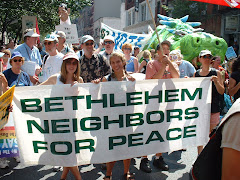
To this end, there will be a mass demonstration in Washington March 20, the 7th anniversary of the war on Iraq. Please see people at the Bethlehem Neighbors for Peace table to get a seat on the bus
Additionally, this summer on July 23 – 25, there will be an historic unity conference in Albany of the national anti-war movement more details will follow soon.
Joe Lombardo
Tuesday, January 19, 2010
Haiti
It must be a tremendous insult to the Haitian people that president Obama appointed George W. Bush along with Bill Clinton to head up relief efforts for Haiti. Although Clinton has a dubious history with Haiti too, Bush is seen as the enemy of Haiti by a great number of people in that country. It was under the Bush administration that the US military was sent to Haiti in the middle of the night to kidnap their elected president, Jean-Bertrand Aristide in 2004. Aristide was put on a US military plane and dropped in the Central African Republic and left there. Aristide had been a very popular president but one the US government didn’t like because of his anti-globalization stand and his insistence that Haiti’s resources and production to be used to better the Haitian people not the multi-national corporations.
Bush also had less than a good record for his administrations response in New Orleans after hurricane Katrina. There, mercenaries from the Blackwater corporation along with National Guard were sent in to keep order as a priority over meeting the needs of the people. The same seems to be happening in Haiti today.
As many are calling for the return of Aristide as a way of unifying the country, the US has sent in the military, supposedly in a humanitarian mission. Other countries did not send their militaries; they sent doctors and disaster recovery experts. The first move the US military did was to take over the airport. As stated in an AP article on January 18, 2010, “Some aid groups and foreign officials have blamed the U.S. military for slowing down aid deliveries, saying the American units that took charge of the small Port-au-Prince airport last week gave priority to U.S. military flights.” In a country where possibly 200,000 have died, where the people are in great need of aid the US is emphasizing security. Is the US afraid that the Haitian government has collapsed and the people might rise up and overthrow the US supported government and perhaps bring back Aristide?
Maybe, with his record in Iraq, Afghanistan and New Orleans, Obama sees Bush as just the right man for the job.
Bush also had less than a good record for his administrations response in New Orleans after hurricane Katrina. There, mercenaries from the Blackwater corporation along with National Guard were sent in to keep order as a priority over meeting the needs of the people. The same seems to be happening in Haiti today.
As many are calling for the return of Aristide as a way of unifying the country, the US has sent in the military, supposedly in a humanitarian mission. Other countries did not send their militaries; they sent doctors and disaster recovery experts. The first move the US military did was to take over the airport. As stated in an AP article on January 18, 2010, “Some aid groups and foreign officials have blamed the U.S. military for slowing down aid deliveries, saying the American units that took charge of the small Port-au-Prince airport last week gave priority to U.S. military flights.” In a country where possibly 200,000 have died, where the people are in great need of aid the US is emphasizing security. Is the US afraid that the Haitian government has collapsed and the people might rise up and overthrow the US supported government and perhaps bring back Aristide?
Maybe, with his record in Iraq, Afghanistan and New Orleans, Obama sees Bush as just the right man for the job.
Sunday, January 17, 2010
AVATAR
Yes, the 3D in the movie AVATAR was incredible as was the world created as the backdrop for the story. But mostly, I liked the politics.
Here is the story where the natives win. It is a story where the invasion and occupation of a foreign land for mineral rights and profit is defeated and the destruction of the environment for profit does not succeed as the entire planet rises up to defeat the invaders and destroyers.
We have all heard of the effort of a true genius, James Cameron, who spent year envisioning this movie and waiting for the technology to catch-up with his ideas. But politically, this movie could not have been produced at any other time. It came out just as the Copenhagen talks on climate change were concluding with an agreement by the rich countries to continue to destroy the planet for profit. It came out as the US is escalating the war in Afghanistan with powerful technologies that the native people of Afghanistan can not match. The themes in AVATAR are exactly parallel.
These themes of US aggression and environmental destruction were not coincidental. This was shown by one of the characters referring to the invasion of the planet as “Shock and Awe,” the term used by the Bush administration to describe the US invasion of Iraq.
Part of the genius of Cameron was how he got the viewer on the side of the indigenous people and against the greed and violence of the corporation and the American mercenaries. Though it was not stated, these were clearly Americans, the shots are called by the representative of the corporation that is trying to exploit the minerals on the planet and the soldiers are clearly mercenaries similar to the Blackwater mercenary bands that have been running lawlessly through Iraq and Afghanistan.
So, the movie is a must see for every science fiction fan and everyone trying to save our environment and bring about a peaceful world.
Here is the story where the natives win. It is a story where the invasion and occupation of a foreign land for mineral rights and profit is defeated and the destruction of the environment for profit does not succeed as the entire planet rises up to defeat the invaders and destroyers.
We have all heard of the effort of a true genius, James Cameron, who spent year envisioning this movie and waiting for the technology to catch-up with his ideas. But politically, this movie could not have been produced at any other time. It came out just as the Copenhagen talks on climate change were concluding with an agreement by the rich countries to continue to destroy the planet for profit. It came out as the US is escalating the war in Afghanistan with powerful technologies that the native people of Afghanistan can not match. The themes in AVATAR are exactly parallel.
These themes of US aggression and environmental destruction were not coincidental. This was shown by one of the characters referring to the invasion of the planet as “Shock and Awe,” the term used by the Bush administration to describe the US invasion of Iraq.
Part of the genius of Cameron was how he got the viewer on the side of the indigenous people and against the greed and violence of the corporation and the American mercenaries. Though it was not stated, these were clearly Americans, the shots are called by the representative of the corporation that is trying to exploit the minerals on the planet and the soldiers are clearly mercenaries similar to the Blackwater mercenary bands that have been running lawlessly through Iraq and Afghanistan.
So, the movie is a must see for every science fiction fan and everyone trying to save our environment and bring about a peaceful world.
Thursday, December 17, 2009
What is Democracy?
I, along with a number of activists in the Albany area, have formed a socialist discussion group in which we read material and hold a discussion on the reading and issues of the day. One new member of our group e-mailed me and asked my opinion on democracy. He asked if there are any examples of democratic functioning states. He also suggested that it might be good to have a 4th branch of government comprised of scientist and other experts who might be better able to respond to climate change and similar issues. Below is my response to his e-mail.
Your e-mail brings up many questions. First of all, I don’t think that we need a panel of experts, such as scientists, as a 4th branch of government. I think that if people were given the facts, we can make decisions that are in our own interest and the interest of all. This is why there is secrecy in our country, they don’t want people to know the truth, it would expose too much. They don’t want people to see the pictures of torture or hear the facts about global warming, etc. Too often we are told that we are too stupid to make decisions for ourselves. This is one way they take democracy away from us; they tell us to leave it in the hands of the experts or the politicians.
I think there have been very few examples of a true democracy in the modern world. In fact, maybe you can’t have a true democracy in a class society because the ruling class, if it is a minority, as in this country, would not want to see its power taken away. On the other hand, if the working class truly took power, the only way we could rule would be democratically because we are the vast majority. There is actually a lot more to talk about here like what happened in the Soviet Union, etc., but that would better be discussed at another time because there is a long history about this.
Although there have been no real models of democracy in the modern world, there have been many attempts that give us a glimpse of what a true democracy might look like. The Paris Commune, where workers took over Paris and parts of France before being crushed by invading armies was one example. Some attempts in Cuba, Nicaragua and other places helped give us a glimpse of what democracy could look like. Basically, Marxist don’t typically equate voting and democracy, like we do in the US. Voting is part of democracy. But in most other industrial countries they have a better system of voting such as proportional representation, requirements for equal access to the media and less involvement of money. In the US, you have to be rich or supported by the rich to run for national office. This is a filter that insures the interests of the rich will be those represented by the government.
In some of the places mentioned above, they tried to organize people on a block by block level. In Cuba, these block committees were called Committees for the Defense of the Revolution. They discuss everything from health care and education in their communities to international politics. They then elect representatives to committees organized on a regional level who elect people to the national level. These are in addition to direct national elections. Additionally, they helped organize women’s organization, labor, farmers, youth and other constituency groups. These groups discuss issues related to their constituencies and also elect people to the regional and national governing bodies.
Additionally, Cuba included the right to have a union as a democratic right. The right to a job is also seen as a democratic right. There are many other areas, besides elections where equality needs to be seen as a democratic right.
I have a friend at work who comes from China. He and many others at our work had a big problem with one of our managers. But nothing could be done about it. Work in the US is a dictatorship. He told me in China, if the workers did not like a manager they would have a meeting and decide that the manager was not good and would be able to get rid of him. In the US, he says, you can criticize the president, which you can’t do in China, but you can not criticize your manager, which you can do in China. Perhaps, if we did not have a capitalist society where work means making a profit for the boss, we would be able to criticize our manager too.
So, I think that in a socialist society, democracy would mean something very different. Since we grew up in a capitalist society we think of it as being the same as voting. In the original US constitution, only white men who owned property could vote. Later, through amendments we allowed all adults citizens to vote. After an uprising the first amendment was added to the constitution which included other rights like the right to free speech and assembly, which we now call democratic rights, but were not there in the beginning. But in a socialist society, we may add the right to housing, healthcare, a job, the right for women to control their own bodies, the right for gays to marry, etc.
Also, in a non-hierarchical society the entire idea of democracy would be different and less adversarial.
So, that’s a longer answer to your e-mail than I intended, but much shorter than needed. Perhaps it would be a good topic to discuss at one of our meetings.
Joe Lombardo
Your e-mail brings up many questions. First of all, I don’t think that we need a panel of experts, such as scientists, as a 4th branch of government. I think that if people were given the facts, we can make decisions that are in our own interest and the interest of all. This is why there is secrecy in our country, they don’t want people to know the truth, it would expose too much. They don’t want people to see the pictures of torture or hear the facts about global warming, etc. Too often we are told that we are too stupid to make decisions for ourselves. This is one way they take democracy away from us; they tell us to leave it in the hands of the experts or the politicians.
I think there have been very few examples of a true democracy in the modern world. In fact, maybe you can’t have a true democracy in a class society because the ruling class, if it is a minority, as in this country, would not want to see its power taken away. On the other hand, if the working class truly took power, the only way we could rule would be democratically because we are the vast majority. There is actually a lot more to talk about here like what happened in the Soviet Union, etc., but that would better be discussed at another time because there is a long history about this.
Although there have been no real models of democracy in the modern world, there have been many attempts that give us a glimpse of what a true democracy might look like. The Paris Commune, where workers took over Paris and parts of France before being crushed by invading armies was one example. Some attempts in Cuba, Nicaragua and other places helped give us a glimpse of what democracy could look like. Basically, Marxist don’t typically equate voting and democracy, like we do in the US. Voting is part of democracy. But in most other industrial countries they have a better system of voting such as proportional representation, requirements for equal access to the media and less involvement of money. In the US, you have to be rich or supported by the rich to run for national office. This is a filter that insures the interests of the rich will be those represented by the government.
In some of the places mentioned above, they tried to organize people on a block by block level. In Cuba, these block committees were called Committees for the Defense of the Revolution. They discuss everything from health care and education in their communities to international politics. They then elect representatives to committees organized on a regional level who elect people to the national level. These are in addition to direct national elections. Additionally, they helped organize women’s organization, labor, farmers, youth and other constituency groups. These groups discuss issues related to their constituencies and also elect people to the regional and national governing bodies.
Additionally, Cuba included the right to have a union as a democratic right. The right to a job is also seen as a democratic right. There are many other areas, besides elections where equality needs to be seen as a democratic right.
I have a friend at work who comes from China. He and many others at our work had a big problem with one of our managers. But nothing could be done about it. Work in the US is a dictatorship. He told me in China, if the workers did not like a manager they would have a meeting and decide that the manager was not good and would be able to get rid of him. In the US, he says, you can criticize the president, which you can’t do in China, but you can not criticize your manager, which you can do in China. Perhaps, if we did not have a capitalist society where work means making a profit for the boss, we would be able to criticize our manager too.
So, I think that in a socialist society, democracy would mean something very different. Since we grew up in a capitalist society we think of it as being the same as voting. In the original US constitution, only white men who owned property could vote. Later, through amendments we allowed all adults citizens to vote. After an uprising the first amendment was added to the constitution which included other rights like the right to free speech and assembly, which we now call democratic rights, but were not there in the beginning. But in a socialist society, we may add the right to housing, healthcare, a job, the right for women to control their own bodies, the right for gays to marry, etc.
Also, in a non-hierarchical society the entire idea of democracy would be different and less adversarial.
So, that’s a longer answer to your e-mail than I intended, but much shorter than needed. Perhaps it would be a good topic to discuss at one of our meetings.
Joe Lombardo
Subscribe to:
Posts (Atom)

 Posts
Posts

