I, along with a number of activists in the Albany area, have formed a socialist discussion group in which we read material and hold a discussion on the reading and issues of the day. One new member of our group e-mailed me and asked my opinion on democracy. He asked if there are any examples of democratic functioning states. He also suggested that it might be good to have a 4th branch of government comprised of scientist and other experts who might be better able to respond to climate change and similar issues. Below is my response to his e-mail.
Your e-mail brings up many questions. First of all, I don’t think that we need a panel of experts, such as scientists, as a 4th branch of government. I think that if people were given the facts, we can make decisions that are in our own interest and the interest of all. This is why there is secrecy in our country, they don’t want people to know the truth, it would expose too much. They don’t want people to see the pictures of torture or hear the facts about global warming, etc. Too often we are told that we are too stupid to make decisions for ourselves. This is one way they take democracy away from us; they tell us to leave it in the hands of the experts or the politicians.
I think there have been very few examples of a true democracy in the modern world. In fact, maybe you can’t have a true democracy in a class society because the ruling class, if it is a minority, as in this country, would not want to see its power taken away. On the other hand, if the working class truly took power, the only way we could rule would be democratically because we are the vast majority. There is actually a lot more to talk about here like what happened in the Soviet Union, etc., but that would better be discussed at another time because there is a long history about this.
Although there have been no real models of democracy in the modern world, there have been many attempts that give us a glimpse of what a true democracy might look like. The Paris Commune, where workers took over Paris and parts of France before being crushed by invading armies was one example. Some attempts in Cuba, Nicaragua and other places helped give us a glimpse of what democracy could look like. Basically, Marxist don’t typically equate voting and democracy, like we do in the US. Voting is part of democracy. But in most other industrial countries they have a better system of voting such as proportional representation, requirements for equal access to the media and less involvement of money. In the US, you have to be rich or supported by the rich to run for national office. This is a filter that insures the interests of the rich will be those represented by the government.
In some of the places mentioned above, they tried to organize people on a block by block level. In Cuba, these block committees were called Committees for the Defense of the Revolution. They discuss everything from health care and education in their communities to international politics. They then elect representatives to committees organized on a regional level who elect people to the national level. These are in addition to direct national elections. Additionally, they helped organize women’s organization, labor, farmers, youth and other constituency groups. These groups discuss issues related to their constituencies and also elect people to the regional and national governing bodies.
Additionally, Cuba included the right to have a union as a democratic right. The right to a job is also seen as a democratic right. There are many other areas, besides elections where equality needs to be seen as a democratic right.
I have a friend at work who comes from China. He and many others at our work had a big problem with one of our managers. But nothing could be done about it. Work in the US is a dictatorship. He told me in China, if the workers did not like a manager they would have a meeting and decide that the manager was not good and would be able to get rid of him. In the US, he says, you can criticize the president, which you can’t do in China, but you can not criticize your manager, which you can do in China. Perhaps, if we did not have a capitalist society where work means making a profit for the boss, we would be able to criticize our manager too.
So, I think that in a socialist society, democracy would mean something very different. Since we grew up in a capitalist society we think of it as being the same as voting. In the original US constitution, only white men who owned property could vote. Later, through amendments we allowed all adults citizens to vote. After an uprising the first amendment was added to the constitution which included other rights like the right to free speech and assembly, which we now call democratic rights, but were not there in the beginning. But in a socialist society, we may add the right to housing, healthcare, a job, the right for women to control their own bodies, the right for gays to marry, etc.
Also, in a non-hierarchical society the entire idea of democracy would be different and less adversarial.
So, that’s a longer answer to your e-mail than I intended, but much shorter than needed. Perhaps it would be a good topic to discuss at one of our meetings.
Joe Lombardo
Thursday, December 17, 2009


Thursday, November 26, 2009
Meeting of the National Assembly
For the last 4 days, I was in San Francisco for a meeting of the coordinating committee of the National Assembly to End the Iraq and Afghanistan Wars and Occupations. Of the 45 members of the coordinating committee, about 30 people from across the country were present (we also hold meetings once per month by phone conference). One member of the coordinating committee who was not present was Lynne Stewart. As you know, Lynne, a now-disbarred attorney, is in jail, having been convicted of aiding terrorism for defending her client, who was accused of being involved with the plot to bomb the World Trade Center in 1993. (For more information on that case and Lynne’s situation, please go to www.lynnestewart.com.) The group gathered at the meeting sent Lynne a note of support, and each of us who know her also wrote a personal note. Mine was also from the Muslim Solidarity Committee, a group that she always thought was doing exemplary work. Lynne let us know that she would like protests at federal buildings on her behalf. People who want to send her a message can write to: Lynne Stewart, 53504-054, MCC-NY, 150 Park Row, New York, NY 10007.
There were two important points that came out of the meeting. The first is that we decided to endorse the call from the ANSWER coalition to have demonstrations on March 20 to commemorate the 7th anniversary of the Iraq War. The National Assembly would have preferred that the ANSWER coalition not put out this call unilaterally but rather to work in conjunction with other national anti-war groups, including the National Assembly, before deciding what to do on the 7th anniversary of the Iraq war. But in the interest of promoting unity in the anti-war movement—a principle that the National Assembly was founded on--we agreed to support and build this action and to try to get other forces to join us.
The second point of importance that came out of the meeting was that we agreed to hold our 3rd national conference in Albany, New York on July 23rd-25th, 2010. This means that national leaders along with hundreds of peace activists from around the country will be coming to meet in Albany. Also present will be members of the peace and progressive movements from other countries. The main function of the National Assembly conference is to assess the state of the movement and to decide on a program of actions during the upcoming period. This will occur during plenary sessions where everyone present will have voice and vote. Additionally, there will be workshops and a large public meeting on Saturday night, along with a panel discussion on Friday. Besides having a fairly strong peace movement in the Capital District, we have done some very good defense work with Muslims who have been attacked in our area and have done some important work with Iraqi refugees. It would be important to showcase this work for the rest of the country and international guests.
The San Francisco meeting also heard reports and discussed situations in Iraq, Afghanistan/Pakistan, Palestine, and Honduras. In addition, we had a discussion on the current state of the anti-war movement. As we all know, the anti-war movement is at a low point. Some of the national groups are not functioning well, if at all. Despite polls that continue to show that the majority are against the Iraq and Afghanistan wars and occupations, anti-war demonstrations and rallies have been much smaller recently than in the past. On October 17, demonstrations took place in 54 cities around the country, but all of them were small. However, discontent with U.S. policies is growing, especially given the present economic environment. We can expect to see a surge in Afghanistan soon, and cities all across the country are preparing a response. The National Assembly believes that this is a very important moment when we must continue to build anti-war organizations and activities in preparation for what we believe will be an inevitable explosion of anti-war sentiment and activity as the wars continue and the honeymoon with the Obama administration ends.
You have probably heard about the explosion of protests on the California campuses after the California a 33% tuition increase was announced. While in California, I was able to take two trips to the Berkley campus, where students have been demonstrating and occupying buildings. These activities are going on throughout the state. The students tie their protest in to the issue of the war using slogans like “Money for schools not for war.” They are also chanting, “This is what democracy looks like,” and “The people united will never be defeated.” Some can argue that the birth of the student movement of the 60s and 70s began with the Berkley Free Speech movement. The students are also aware of the connection of their movement to the plight of union workers who are being laid off; the biggest cheers at their rally came when some fired janitors spoke. Teachers and other workers throughout California are suffering from the cutbacks and protesting too. California reflects the future of all states across the country, as our nation's corporate elite try to shift more and more wealth from the working people and the poor to the corporations and the already obscenely rich. People working on all issues, from war to healthcare to tuition hikes, need to come together and join in one fight against a common enemy. With this understanding in mind, the National Assembly sent a message of support to the striking students.
There are many union activists on the coordinating committee of the national assembly, included the presidents of two state-wide labor federations. The group took note of the resolution that came from our own Troy Area Labor Council calling for the AFL-CIO leadership to organize a mass action around the issues of jobs, the war, and health care. A similar call was passed by the Wisconsin state AFL-CIO federation, the San Francisco Labor Council and a number of other labor groups. We see such calls as extremely hopeful signs and as a way forward for the movement as a whole. They point toward our developing a real fight-back against the attacks being directed at the American people today. The Albany conference in 2010 will be a very important step in that direction, as well. I hope all activists in our area will join me in building this conference.
Peace,
Joe Lombardo
There were two important points that came out of the meeting. The first is that we decided to endorse the call from the ANSWER coalition to have demonstrations on March 20 to commemorate the 7th anniversary of the Iraq War. The National Assembly would have preferred that the ANSWER coalition not put out this call unilaterally but rather to work in conjunction with other national anti-war groups, including the National Assembly, before deciding what to do on the 7th anniversary of the Iraq war. But in the interest of promoting unity in the anti-war movement—a principle that the National Assembly was founded on--we agreed to support and build this action and to try to get other forces to join us.
The second point of importance that came out of the meeting was that we agreed to hold our 3rd national conference in Albany, New York on July 23rd-25th, 2010. This means that national leaders along with hundreds of peace activists from around the country will be coming to meet in Albany. Also present will be members of the peace and progressive movements from other countries. The main function of the National Assembly conference is to assess the state of the movement and to decide on a program of actions during the upcoming period. This will occur during plenary sessions where everyone present will have voice and vote. Additionally, there will be workshops and a large public meeting on Saturday night, along with a panel discussion on Friday. Besides having a fairly strong peace movement in the Capital District, we have done some very good defense work with Muslims who have been attacked in our area and have done some important work with Iraqi refugees. It would be important to showcase this work for the rest of the country and international guests.
The San Francisco meeting also heard reports and discussed situations in Iraq, Afghanistan/Pakistan, Palestine, and Honduras. In addition, we had a discussion on the current state of the anti-war movement. As we all know, the anti-war movement is at a low point. Some of the national groups are not functioning well, if at all. Despite polls that continue to show that the majority are against the Iraq and Afghanistan wars and occupations, anti-war demonstrations and rallies have been much smaller recently than in the past. On October 17, demonstrations took place in 54 cities around the country, but all of them were small. However, discontent with U.S. policies is growing, especially given the present economic environment. We can expect to see a surge in Afghanistan soon, and cities all across the country are preparing a response. The National Assembly believes that this is a very important moment when we must continue to build anti-war organizations and activities in preparation for what we believe will be an inevitable explosion of anti-war sentiment and activity as the wars continue and the honeymoon with the Obama administration ends.
You have probably heard about the explosion of protests on the California campuses after the California a 33% tuition increase was announced. While in California, I was able to take two trips to the Berkley campus, where students have been demonstrating and occupying buildings. These activities are going on throughout the state. The students tie their protest in to the issue of the war using slogans like “Money for schools not for war.” They are also chanting, “This is what democracy looks like,” and “The people united will never be defeated.” Some can argue that the birth of the student movement of the 60s and 70s began with the Berkley Free Speech movement. The students are also aware of the connection of their movement to the plight of union workers who are being laid off; the biggest cheers at their rally came when some fired janitors spoke. Teachers and other workers throughout California are suffering from the cutbacks and protesting too. California reflects the future of all states across the country, as our nation's corporate elite try to shift more and more wealth from the working people and the poor to the corporations and the already obscenely rich. People working on all issues, from war to healthcare to tuition hikes, need to come together and join in one fight against a common enemy. With this understanding in mind, the National Assembly sent a message of support to the striking students.
There are many union activists on the coordinating committee of the national assembly, included the presidents of two state-wide labor federations. The group took note of the resolution that came from our own Troy Area Labor Council calling for the AFL-CIO leadership to organize a mass action around the issues of jobs, the war, and health care. A similar call was passed by the Wisconsin state AFL-CIO federation, the San Francisco Labor Council and a number of other labor groups. We see such calls as extremely hopeful signs and as a way forward for the movement as a whole. They point toward our developing a real fight-back against the attacks being directed at the American people today. The Albany conference in 2010 will be a very important step in that direction, as well. I hope all activists in our area will join me in building this conference.
Peace,
Joe Lombardo
Monday, October 12, 2009
Health Care Costs
The following is a letter of mine that was in the Albany Times Union today. The letter is on healthcare costs and advocates for a single payer solution. The only piece that the editors took out of my letter was a sentence where I supported my statement that the insurance executives get "over-the-top salaries and bonuses" by using the example of Stephen Hemsley, CEO of United Healthcare who makes $102,742.00 per hour
Health plan may benefit wealthy
First published: Monday, October 12, 2009
In "Health costs hit home" (Oct. 3), the Times Union reports that
health care costs will rise steeply again this year. This is at the
same moment when health care reform bills are making their way through Congress without serious consideration being given to single-payer health care or even the nebulous public option.
With the way things are headed, it looks like people who can barely
afford the co-pay for a visit to their doctor will be mandated to buy
a defective and exorbitant health insurance policy or else face a
fine. This is a huge giveaway to the health insurance industry and,
like the recent corporate bailouts, is essentially another transfer of
wealth from working people and the poor to the rich.
A recent study comparing the U.S. health care system to that of five
other industrial countries, reported by the New York Daily News,
concludes that ours is twice as costly per capita as any of the others
and has worse outcomes, to boot. The other five countries all have
some form of single-payer system.
The high cost of health care in the U.S. is the direct result of
greedy insurance companies, with their high overhead and over-the-top salaries and bonuses for their executives.
Health care costs more in this country than any place else on the
planet because we put the profits of the corporations above the needs of the people. The only way to remove the insurance companies -- the Number One enemy of meaningful health care reform in this country -- from the equation is to adopt a single payer system.
Joe Lombardo
Health plan may benefit wealthy
First published: Monday, October 12, 2009
In "Health costs hit home" (Oct. 3), the Times Union reports that
health care costs will rise steeply again this year. This is at the
same moment when health care reform bills are making their way through Congress without serious consideration being given to single-payer health care or even the nebulous public option.
With the way things are headed, it looks like people who can barely
afford the co-pay for a visit to their doctor will be mandated to buy
a defective and exorbitant health insurance policy or else face a
fine. This is a huge giveaway to the health insurance industry and,
like the recent corporate bailouts, is essentially another transfer of
wealth from working people and the poor to the rich.
A recent study comparing the U.S. health care system to that of five
other industrial countries, reported by the New York Daily News,
concludes that ours is twice as costly per capita as any of the others
and has worse outcomes, to boot. The other five countries all have
some form of single-payer system.
The high cost of health care in the U.S. is the direct result of
greedy insurance companies, with their high overhead and over-the-top salaries and bonuses for their executives.
Health care costs more in this country than any place else on the
planet because we put the profits of the corporations above the needs of the people. The only way to remove the insurance companies -- the Number One enemy of meaningful health care reform in this country -- from the equation is to adopt a single payer system.
Joe Lombardo
Saturday, September 12, 2009
Right-wing Mobilizes in Washington
Today, tens of thousands of right-wing tea bag supporters marched on Washington. From the images I saw on the internet, there were well over 100,000 (it turned out that the images I saw on the internet were forged. They were of a previous demonstration and the tea-bag demo had far few people). While we on the left debate whether demonstrations do or don't work, the right-wing is mobilizing and is out on the streets like I have never seen them do before in my lifetime. These mobilizations have had a big effect. They have moved the healthcare debate to the right and taken the momentum that the left felt with the ending of the Bush administration and the election of a Black president and turned it into a right-wing momentum against any progressive change.
One of the key differences between a right-wing government and a fascist movement is that a fascist movement gets people mobilized in the streets. When they get strong enough, they break up union meetings and physically attack their political opponents. I characterize the right-wing mobilizations that we have seen as an incipient fascist movement. It is clear to me that there are people, such as the talk show hosts, who are trying to build such a movement. This is both a huge threat and a big challenge to the left. During this period of history, I believe we are the ones who will literally make the decision of whether or not humankind is going to make it. The only way we'll survive is if we can stop the ravages of war, build a peaceful world without nuclear weapons, put the brakes on global warming and the end the depletion of our natural resources.
These right-wingers are motivated in part by the realities of our times. The lives of working people are getting worse and worse as healthcare becomes less affordable, people are losing their jobs due to corporate greed, and the living standard of the vast majority of the working class continues its downward slide. In this rampantly racist country, we've elected a black president, signaling to the right wing that they are losing what blacks are gaining. Besides the blacks, they scapegoat immigrants and Muslims, whom they blame for their misery. It is this anger that is moving them into the streets.
The left should always be able to out-mobilize the right even though we don’t have corporate wealth and the media behind us like they do. This is because our issues of peace and justice speak to the real needs of people and to viable solutions to our collective problems. It's also because our movement is inclusive of everyone--young or old, black or white, gay or straight, Christian, Muslim, or atheist.
I urge people to get out in the streets. Join your local peace vigil; come to the events sponsored by our progressive organizations; join the picket line of the hotel workers at the Holiday Inn Express in Latham as they fight to form a union. I urge you to join in our local anti-war protest on October 17, which will coincide with similar rallies throughout the country (see www.nepajac.org). The right is taking our tactic of mass mobilization and using it their advantage. Let's not let that happen.
One of the key differences between a right-wing government and a fascist movement is that a fascist movement gets people mobilized in the streets. When they get strong enough, they break up union meetings and physically attack their political opponents. I characterize the right-wing mobilizations that we have seen as an incipient fascist movement. It is clear to me that there are people, such as the talk show hosts, who are trying to build such a movement. This is both a huge threat and a big challenge to the left. During this period of history, I believe we are the ones who will literally make the decision of whether or not humankind is going to make it. The only way we'll survive is if we can stop the ravages of war, build a peaceful world without nuclear weapons, put the brakes on global warming and the end the depletion of our natural resources.
These right-wingers are motivated in part by the realities of our times. The lives of working people are getting worse and worse as healthcare becomes less affordable, people are losing their jobs due to corporate greed, and the living standard of the vast majority of the working class continues its downward slide. In this rampantly racist country, we've elected a black president, signaling to the right wing that they are losing what blacks are gaining. Besides the blacks, they scapegoat immigrants and Muslims, whom they blame for their misery. It is this anger that is moving them into the streets.
The left should always be able to out-mobilize the right even though we don’t have corporate wealth and the media behind us like they do. This is because our issues of peace and justice speak to the real needs of people and to viable solutions to our collective problems. It's also because our movement is inclusive of everyone--young or old, black or white, gay or straight, Christian, Muslim, or atheist.
I urge people to get out in the streets. Join your local peace vigil; come to the events sponsored by our progressive organizations; join the picket line of the hotel workers at the Holiday Inn Express in Latham as they fight to form a union. I urge you to join in our local anti-war protest on October 17, which will coincide with similar rallies throughout the country (see www.nepajac.org). The right is taking our tactic of mass mobilization and using it their advantage. Let's not let that happen.
Sunday, August 30, 2009
Health Care Town Hall Meetings


In the Capital District we have had a series of congressional town meetings like those in other areas; however, in our case, the right-wing has not been allowed the upper hand and hasn't been successful in disrupting the meetings. At the two town hall meetings that I attended, progressives have outnumbered the right-wing and prevented them from shouting down single-payer or government option opinions.
The left needs to take stock of what is going on at these meetings and insure that they are not disrupted by these modern day Brown Shirts. There are fewer and fewer places for public debate in this country, as the media becomes more and more tightly controlled and as public spaces give way to privately owned malls. So, when congress members come back to their districts to hold town hall meetings to hear what their constituents think, we should use them to make our progressive voices heard and not allow them to be taken over by the right-wing.
These right-wingers must be confused and demoralized when they find themselves outnumbered at these meetings. If their primary news sources are FOX News and the fascist minded talk show hosts, they must not understand a forum where opposing voices are allowed to be heard and where the propaganda that they hear gets challenged. The right-wing talk show hosts use the technique of talking over opinions that they don’t want you to hear, and so their listeners try to do the same thing at these health care reform meetings. But when we outnumber them, they can't get away with this.
Additionally, some who come from the Ron Paul or Libertarian perspective agree with us on many issues like the ending the wars and occupations or opposing the bank bailouts. They typically support gay rights and the right to abortion. Others are against any government healthcare option or single-payer because they believe that they will pay for abortions. We should exploit these differences, divide them from each other and even make common cause with some where we can.
Can Government Do Anything Right?
Although there are many issues that bring right-wingers to these town hall meetings with obvious anger and passion, when you cut away the lies and misinformation, the main issue is mistrust of government. Some of this is justified; there is reasonable anger from both the right and the left over the bank bailouts and the welfare for the rich, for example. However, when this criticism comes from the right, it takes the form of scapegoating. Many of the right-wingers that I see at these meetings look like they are not well off. One man told me that it was a government lie that 50,000,000 people don’t have health care in the US. During the discussion, he admitted that he himself did not have healthcare. But he sure as hell did not want any “illegal aliens” to get it, and his unrestrained racist anger at Obama was clearly coming from the same racist position, where he believed people whom he considered beneath him were getting ahead of him. It is this same racism, along with anti-Semitism and sexism and homophobia that has always fueled right-wing movements.
The difference between the right-wing and left-wing positions on the failures of our government is this: the right insists that the government do nothing, while the left demands that the government does what it is supposed to do: provide for human needs that the people cannot do for themselves, like building the roads and bridges, organizing fire departments, running schools, and making sure that we all have healthcare.
The Downside
While the local meetings are forcing progressives to mobilize in response to the right-wing mobilizations, and while we support the kind of participatory democracy that these meetings may represent, there are downsides to these meetings too. They have shifted the health care debate to the right. There are many who support a single-payer option but feel a need to defend the public option because that is the brunt of the attack from the insurance companies and the Republicans. So the debate has become the status quo verses the public option, and single-payer has become marginalized. However, at the meetings I attended, if there had been a vote on what the people wanted, I'm pretty sure that single-payer would have won. Because of this, those of us who support single-payer must be bold in expressing this at these meetings and elsewhere.
Another downside of these meetings is that the centrality of the health care debate during this period has pushed other issues to the side. This is most apparent with anti-war issue; while the wars continue to escalate, our attention has been focused on healthcare. As a result, terrible decisions have been coming out of the Obama administration, with little opposition. These include escalating the wars, continuing of extraordinary renditions, continued cover-ups of war crimes, etc. The fall anti-war actions will be an important step towards moving these issues back to center stage (see www.nepajac.org.
Mobilization
It is important that we continue to mobilize when these types of situations arise. By doing so, at least in this area, we have been able to change the news coverage from the national perspective of mobs of people opposing any government involvement in health care to one of a public debate on healthcare. A debate on the issue will always work in our favor, since it allows us to show the superior single-payer type systems that exist in other countries.
During these mobilizations, single-payer advocates have made common cause with government option advocates in opposition to the misinformation and behavior of the right-wing. In my opinion, this is good and necessary. It would be a mistake for us to allow ourselves to be split from good folks with whom we can work on a number of issues. The divide and conquer tactic of the US government in Iraq and Afghanistan has been used very effectively. It has also been used in the US anti-war movement, where some coalitions will not even admit the existence of other peace coalitions let alone join in actions with them. We cannot let this happen to the healthcare movement. I say this even though I believe that the only viable option is the single-payer option, since a government option would still keep the insurance companies in the picture, keep health care costs high, and continue to allow abuses, which will eventually lead to a rejection of any public option and prove the right-wing's point that government can’t do anything right.
It is very important for people to understand that voting or having one's own position on an issue is not enough. It is important for people to understand that they need to act and that their actions have an effect. This is not taught by the media, the government, or the schools. We learn that democracy equals voting; then you go shopping or watch commercials on TV and let the elected officials do the work for you. As we mobilize for these town meetings, we feel our strength. We see that our mobilization is able to change the character of these meeting. Although we don’t have the money or control that the insurance companies and other private corporations have, and we don’t have the lobbying power or money to make the large campaign contributions, the power of a united people is the greatest power of all. Just by putting our hands in our pockets and refusing to cooperate, we can bring the country to a standstill. So as people start demanding to take the profit out of healthcare and see resistance from the government and the corporations, we become a little more conscious of the fact that we are not on the same side and that they are not working for our benefit. It brings us a little closer to understanding that if we are to make the basic changes that we need, the only thing we can rely on is our own collective, organized strength.
Single-payer verses Socialized Medicine
A single-payer system is what we need to fight for now. It is the demand that addresses the concerns of the American people, including rising medical costs, rising unemployment, and increasingly unscrupulous practices of the insurance companies during this period of neo-liberalism. However, what single-payer does is replace the insurance industry with the government. Despite the rhetoric of the right-wing, it is not socialized medicine. The hospitals and the pharmaceutical companies and other health care services will still remain private, for-profit organizations. These institutions will continue to put profit over the needs of people. This will remain an obstacle to providing quality healthcare, even with a single-payer system. During this debate, we should point out that the right-wing claims that a public option or single-payer system is socialized medicine are wrong and use the debate to talk about what a real socialize system would look like and tie it into the devastating effects that private industry has had in all areas from Enron to the bank bailouts.
The debate around healthcare will push the debate around what kind of society we need in general.
Wednesday, August 12, 2009

Thoughts on the 5th anniversary of the arrest of Yassim Aref and Mohammed Hossain.
On Tuesday, August 4, 2009 over 100 people marched through the streets of Albany, New York to protest the FBI's tricking Yassim Aref and Mohammed Hossain into doing something that could look as if it was illegal and then putting them in jail for 15 years. The protesters marched from downtown Albany to a rally at the Masjid As-Salam Mosque, where both men used to worship. The march and rally was sponsored by the Muslim Solidarity Committee and a number of other local peace and justice groups, including my own, Bethlehem Neighbors for Peace. The Troy Record article on the march and rally can be found at the link below:
http://www.troyrecord.com/articles/2009/08/05/news/doc4a78fd56e5a06730396981.txt
Five years ago, I was with Mark Dunlea, an Albany activist, and Dave McReynolds, a peace activist (who was then the Green Party candidate for Senator from New York), when we heard that two "terrorists" had been arrested in Albany and that there would be a press conference about the arrests. The three of us jumped into my car and drove down to the press conference, where we found Governor Pataki, New York Senator Schumer and Albany Mayor Jennings talking tough about fighting terrorist activity in Albany. We decided to go to the mosque that had been attacked to hear their side of the story. When we arrived, we found a wall of cameras and press from everywhere in the country taking pictures of the inner-city, store-front mosque. The door was locked, but we noticed that there was a grocery store next to the mosque in which there were several men wearing Muslim garb. We went in and found that one of the men, named Faisal, was the son of the president of the mosque. We talked a little about what had happened, and it became clear to me that the arrested men were victims, not criminals, and needed support, especially from the non-Muslim community. I exchanged contact information with Faisal. A few weeks later, he and a couple of others from the mosque joined a support meeting at the Women’s Building on Central Avenue that had been called by Erin O’Brien and me. At the meeting, Faisal welcomed our support, but he was not sure about conducting a public campaign, so we agreed to stay in contact and to continue to discuss what we could do.
From the very start of this case, it was clear to me that this case had nothing to do with terrorism. This is because:
1. I was an anti-war activist, and as such, I had thought about the phony War on Terror and had come to understand it as the US government’s justification for its imperial wars;
2. I had been involved in defending another man from the same mosque, Imam Umar, who was also attacked for fabricated reasons used to justify their war on Terror.
The Case of Imam Umar
Imam Umar had worked for 25 years as a Muslim chaplain in the New York state prison system, eventually becoming the head of all chaplains in the state prisons. He was one of the first two Muslim chaplains in the US prisons; he founded the National Association of Muslim Chaplains and became its president. After the attacks on 9/11, the U.S. government sought to foster an atmosphere of fear in this country as a way of mobilizing people for war. The targets of their fear campaign were Arabs and Muslims in this country and around the world, who were branded as terrorists or supporters of terrorism. President Bush claimed that the US was attacked because these people hated our freedom and democracy. Imam Umar explained that this was not true, that people throughout the world all love freedom and democracy but that many people, especially in the third world, have legitimate grievances against the United States. Unless these were seriously addressed, he believed, we could never hope to stop terrorism.
This kind of talk coming from a Black man and a Muslim could not be tolerated during the US build up for war, so Imam Umar was attacked by the government and the news media. They characterized him as promoting terrorism within the Muslim prison population. Articles attacking him appeared in the Wall Street Journal, the New York Times, and other news media. New York Governor Pataki and Senator Schumer spoke out against him. Pataki denied him access to the New York State prisons, and Schumer called for the firing of all Muslim chaplains in the New York state prison system.
Eventually, police raided Imam Umar’s home and carted away books, tapes, computers, financial records, his kids' game systems, and other personally possessions. They charged him with owning a .22 caliber rifle and a shot gun, which he had owned for several decades, since the time he had owned a farm in upstate New York. This was a crime, according to a law that Imam Umar wasn't aware of, which didn't allow him to own guns because he'd been arrested on a felony charge as a teenager over 38 years earlier. The government prosecuted him on this charge and tried to get him put in jail for 10 years.
Bethlehem Neighbors for Peace (BNP) organized a defense. It was a very public defense with rallies, press conferences, petitions, and letter writing campaigns. We had Imam Umar speak at anti-war demonstrations, and we mobilized public support for him. We organized people to attend the court appearances in Manhattan. The government tried to get Imam Umar to take a plea deal requiring him not to appeal his conviction and to serve a little over a year and a half in prison. Umar refused the plea deal, and he went to trial, where he admitted owning the rifle and shotgun. BNP then organized a campaign to send letters to the judge asking for leniency in his sentencing. Letters came from neighbors, teachers, professors, doctors, and others representing a broad cross section of the population in the Bethlehem and Albany communities.
At the sentencing hearing, Umar gave a political talk explaining what the prosecution of him was about. Then the judge gave a long talk that was sympathetic to Imam Umar; the judge seemed to understand that he had done nothing wrong and took the prosecution to task for prosecuting the case. For Imam Umar's “crime,” he received a $100 fine and one-year's worth of home imprisonment with very liberal exceptions. Umar was allowed to leave home to work, for medical reasons, and for religious practice. Umar then stood up in court and told the judge that he would refuse to wear an ankle bracelet, a device used to ensure that he is where he is mandated to be. He stated that this ankle bracelet was a throwback to the shackles worn by slaves, and he would not allow his children to see him this way. The judge agreed that he did not have to wear the ankle bracelet.
Today, Imam Umar is back in court, but this time, Umar is the plaintiff and the government is the defendant. The government has refused to return Umar’s belongings, which they took when they raided his home and have never returned.
Forming the Muslim Solidarity Committee
After the arrests of Aref and Hosssain, and after the first meeting at the Women’s Building, a second meeting was held at the Quaker Meeting House, on Washington Avenue in Albany, to form a defense committee for Aref and Hossain. About 50 people attended this meeting, including five or so from the mosque. Cathy Callan and May Safar took the leadership of the organization and were essential in its initial development. Cathy had experience as a member of the Imam Umar defense committee, which had been organized earlier by Bethlehem Neighbors for Peace, and the Muslim Solidarity Committee took a similar open and public posture. We organized petitions, rallies, and public meetings. We reached out to the media, and as the trial started, we organized vigils outside of the court house and packed the court room with supporters.
In an Alice in Wonderland trial where everything was upside down and inside out, Aref and Hossain were convicted. The trial was tainted by secret evidence, “experts” with no knowledge of the field they were supposedly expert in, mistranslations, a government witness who was also a criminal, and a judge who instructed the jury that they could not hear all the evidence because it was classified, although he assured them that the unseen evidence was good. Above all, there had been no crime.
What the FBI had done was to invent a crime and then did what it had to do to make it look like Aref and Hossain went along with it. The FBI did this so they could make Americans feel we are in danger from Muslims and that we should therefore support the murders of Muslims in Iraq and Afghanistan and willingly sign away our civil liberties here at home. They used a tactic described as “pre-emptive prosecution," which has as much validity as the “pre-emptive wars” that the U.S. has been fighting, neither of which make the people of the United States any more safe or secure--in fact, quite the opposite.
The brief details of the case are that the government caught a Pakistani man name Malik selling illegal drivers licenses to other immigrants. They told him he was facing long prison time, but they could make the crime and prison time go away if he would participate in a sting operation to put Aref and Hossain in jail. When all of this started, Hossain, who owned a local pizza place, was having financial trouble. Malik started going to the mosque, befriended Hossain, and offered to loan him money. In the Muslim religion, interest on a loan is not permitted, so Malik made other arraignments: he would give Hossain more than the $5,000 he needed, and Hossain would return the rest. He explained that having money come from Hossain in this way was something that was needed for his import business. Hossain agreed, but he wanted it all in writing and wanted Aref, the Imam of the mosque, to validate that it was all legal according to Islamic law. This is a common practice among Muslims. All the meetings between Malik and Hossain, and later with Aref, were taped by the FBI.
Slowly, as the meetings progressed, Malik started telling Hossain that he was going to use some of the money returned from Hossain for a hand-held missile to be used against a Pakistani official. Hossain objected, but continued with the loan arrangements and didn’t turn Malik in, so he was an accessory to a phony terrorist plot invented by the FBI. Aref claims that he did not know about the hand held missile but the government claims that he did. Although the government was taping the meetings the tape that had the “proof” that Aref knew had a problem and the “proof” never got taped. However, Malik’s FBI handler claimed that he was listening over Milik’s wire from his car and he heard Aref being told about the plot. Aref and Hossain were convicted in an atmosphere of fear and anger directed towards Muslims after 9/11.
The Muslim Solidarity Committee organized the community to send letters to the judge, just as we had done with Imam Umar. We packed the courtroom during the sentencing and had others outside the court holding a vigil. Aref and Hossain made statements at the sentencing hearing Aref’s statement was defiant and political; he condemned the government as the real criminal. The federal sentencing guidelines called for each man to be sentenced to 30 years in prison, but the judge recognized mitigating circumstances, including the large amount of community support, and instead sentenced each man to 15 years in prison.
The sentence of Aref and Hossain not only was a tremendous blow to them and to all Muslims and justice loving people, but it was tremendously devastating to their families. The Muslim Solidarity Committee and other community members have been doing their best to support the families. We have helped them with housing, schooling for their children, visits to the prisons, and other basic needs. If the aim of the FBI was to create a wedge between the Muslim and non-Muslim communities, they did not succeed.
As the Muslim Solidarity Committee took form with listservs, websites, and a group of very committed people, we started learning about other similar cases in upstate New York and throughout the country. As a result, on the fourth anniversary of the arrest of Aref and Hossain, the Muslim Solidarity Committee held a conference with others working on similar cases. There, the Muslim Innocence Project, which became Project Salam (http://www.projectsalam.org/), a web site that seeks to collect Muslims throughout the country who also have been wrongly prosecuted, was formed. We hope to use this project as a way to further expose the government's crimes.
As a result of this effort to reach out to others who have been wrongly prosecuted, we came in contact with the other groups of Muslims in similar situations, including a group from Newburgh, New York that the FBI and Malik tricked, and another group from Philadelphia known as the Ft. Dix Five. Family members and supporters of these groups joined our march and rally in Albany. While at the rally at the mosque, I spoke to one of the supporters from Philadelphia. He was trying to figure how the Muslim Solidarity Committee had accomplished so much. He mentioned that in Philadelphia, the mosques would not touch the case of the Fort Dix Five and would never have held a rally for the wrongly prosecuted Muslims. He was very impressed that non-Muslims and Muslims were working together and marching together for justice.
Thinking about his question inspired me to write up this account. I think the answer to his question is our decision to be very public with our campaign and because we have incredibly committed people.
Going Public
It is not always obvious to people that they should run a public campaign to defend someone who has been wrongfully prosecuted. Some people think that if you were to go public, you could anger the prosecution and the judge and they might therefore be harsher on the defendant. Lawyers sometimes advise against doing a public defense campaign, believing that they can make the best arguments to sway the court and that a public campaign could hurt their efforts. In my experience, both of these positions are wrong. They come from the notion that the government and the prosecution must have just made a mistake and so, with enough logic and argument, we could point this out to them and they would then do the right thing. I don’t think so. The firing of federal prosecutors who refused to conduct political prosecutions under the Bush administration is a clear sign that they know exactly what they are doing. Unfortunately, under the Obama administration, the same group of federal prosecutors is still doing the same thing as they did under Bush.
The analysis presented in this article takes the position that the government and the prosecution know they are going after innocent men, are doing it for their own political reasons, and will not be swayed by argument. What might sway them is shining the light of day to their crimes, exposing their egregious violations of civil liberties and due process rights. This might cause them to back off, because the only power that can oppose the power of the courts, the police, and the government is the power of the people. This can happen only if people see the truth of what is going on and thus have a consciousness raising experience. Our campaigns in support of Aref and Hossain and other wrongfully prosecuted Muslims have helped expose the misdeed of the government. The government and the FBI have been made to pay a price, which they are still paying.
Committed people
To conduct such a public campaign requires committed and brave people. The Muslim Solidarity Committee consists of such courageous people. It includes lawyers who have given of their time and efforts, for no pay, to achieve justice. We have the brave people from the Mosque who attended our rally and prayed and ate with us on August 4th, at a time when Muslims are still being set up. We have courageous and articulate defendants like Hossain and Aref, and a great group of people organizing meetings, web sites, transportation, editing writings and raising money.
It is my hope that some of the lessons of our experience will be learned and replicated throughout the country. If this were to happen, the government would think twice about wrongfully prosecuting people. They would have to decide if they have more to lose than gain.
On Tuesday, August 4, 2009 over 100 people marched through the streets of Albany, New York to protest the FBI's tricking Yassim Aref and Mohammed Hossain into doing something that could look as if it was illegal and then putting them in jail for 15 years. The protesters marched from downtown Albany to a rally at the Masjid As-Salam Mosque, where both men used to worship. The march and rally was sponsored by the Muslim Solidarity Committee and a number of other local peace and justice groups, including my own, Bethlehem Neighbors for Peace. The Troy Record article on the march and rally can be found at the link below:
http://www.troyrecord.com/articles/2009/08/05/news/doc4a78fd56e5a06730396981.txt
Five years ago, I was with Mark Dunlea, an Albany activist, and Dave McReynolds, a peace activist (who was then the Green Party candidate for Senator from New York), when we heard that two "terrorists" had been arrested in Albany and that there would be a press conference about the arrests. The three of us jumped into my car and drove down to the press conference, where we found Governor Pataki, New York Senator Schumer and Albany Mayor Jennings talking tough about fighting terrorist activity in Albany. We decided to go to the mosque that had been attacked to hear their side of the story. When we arrived, we found a wall of cameras and press from everywhere in the country taking pictures of the inner-city, store-front mosque. The door was locked, but we noticed that there was a grocery store next to the mosque in which there were several men wearing Muslim garb. We went in and found that one of the men, named Faisal, was the son of the president of the mosque. We talked a little about what had happened, and it became clear to me that the arrested men were victims, not criminals, and needed support, especially from the non-Muslim community. I exchanged contact information with Faisal. A few weeks later, he and a couple of others from the mosque joined a support meeting at the Women’s Building on Central Avenue that had been called by Erin O’Brien and me. At the meeting, Faisal welcomed our support, but he was not sure about conducting a public campaign, so we agreed to stay in contact and to continue to discuss what we could do.
From the very start of this case, it was clear to me that this case had nothing to do with terrorism. This is because:
1. I was an anti-war activist, and as such, I had thought about the phony War on Terror and had come to understand it as the US government’s justification for its imperial wars;
2. I had been involved in defending another man from the same mosque, Imam Umar, who was also attacked for fabricated reasons used to justify their war on Terror.
The Case of Imam Umar
Imam Umar had worked for 25 years as a Muslim chaplain in the New York state prison system, eventually becoming the head of all chaplains in the state prisons. He was one of the first two Muslim chaplains in the US prisons; he founded the National Association of Muslim Chaplains and became its president. After the attacks on 9/11, the U.S. government sought to foster an atmosphere of fear in this country as a way of mobilizing people for war. The targets of their fear campaign were Arabs and Muslims in this country and around the world, who were branded as terrorists or supporters of terrorism. President Bush claimed that the US was attacked because these people hated our freedom and democracy. Imam Umar explained that this was not true, that people throughout the world all love freedom and democracy but that many people, especially in the third world, have legitimate grievances against the United States. Unless these were seriously addressed, he believed, we could never hope to stop terrorism.
This kind of talk coming from a Black man and a Muslim could not be tolerated during the US build up for war, so Imam Umar was attacked by the government and the news media. They characterized him as promoting terrorism within the Muslim prison population. Articles attacking him appeared in the Wall Street Journal, the New York Times, and other news media. New York Governor Pataki and Senator Schumer spoke out against him. Pataki denied him access to the New York State prisons, and Schumer called for the firing of all Muslim chaplains in the New York state prison system.
Eventually, police raided Imam Umar’s home and carted away books, tapes, computers, financial records, his kids' game systems, and other personally possessions. They charged him with owning a .22 caliber rifle and a shot gun, which he had owned for several decades, since the time he had owned a farm in upstate New York. This was a crime, according to a law that Imam Umar wasn't aware of, which didn't allow him to own guns because he'd been arrested on a felony charge as a teenager over 38 years earlier. The government prosecuted him on this charge and tried to get him put in jail for 10 years.
Bethlehem Neighbors for Peace (BNP) organized a defense. It was a very public defense with rallies, press conferences, petitions, and letter writing campaigns. We had Imam Umar speak at anti-war demonstrations, and we mobilized public support for him. We organized people to attend the court appearances in Manhattan. The government tried to get Imam Umar to take a plea deal requiring him not to appeal his conviction and to serve a little over a year and a half in prison. Umar refused the plea deal, and he went to trial, where he admitted owning the rifle and shotgun. BNP then organized a campaign to send letters to the judge asking for leniency in his sentencing. Letters came from neighbors, teachers, professors, doctors, and others representing a broad cross section of the population in the Bethlehem and Albany communities.
At the sentencing hearing, Umar gave a political talk explaining what the prosecution of him was about. Then the judge gave a long talk that was sympathetic to Imam Umar; the judge seemed to understand that he had done nothing wrong and took the prosecution to task for prosecuting the case. For Imam Umar's “crime,” he received a $100 fine and one-year's worth of home imprisonment with very liberal exceptions. Umar was allowed to leave home to work, for medical reasons, and for religious practice. Umar then stood up in court and told the judge that he would refuse to wear an ankle bracelet, a device used to ensure that he is where he is mandated to be. He stated that this ankle bracelet was a throwback to the shackles worn by slaves, and he would not allow his children to see him this way. The judge agreed that he did not have to wear the ankle bracelet.
Today, Imam Umar is back in court, but this time, Umar is the plaintiff and the government is the defendant. The government has refused to return Umar’s belongings, which they took when they raided his home and have never returned.
Forming the Muslim Solidarity Committee
After the arrests of Aref and Hosssain, and after the first meeting at the Women’s Building, a second meeting was held at the Quaker Meeting House, on Washington Avenue in Albany, to form a defense committee for Aref and Hossain. About 50 people attended this meeting, including five or so from the mosque. Cathy Callan and May Safar took the leadership of the organization and were essential in its initial development. Cathy had experience as a member of the Imam Umar defense committee, which had been organized earlier by Bethlehem Neighbors for Peace, and the Muslim Solidarity Committee took a similar open and public posture. We organized petitions, rallies, and public meetings. We reached out to the media, and as the trial started, we organized vigils outside of the court house and packed the court room with supporters.
In an Alice in Wonderland trial where everything was upside down and inside out, Aref and Hossain were convicted. The trial was tainted by secret evidence, “experts” with no knowledge of the field they were supposedly expert in, mistranslations, a government witness who was also a criminal, and a judge who instructed the jury that they could not hear all the evidence because it was classified, although he assured them that the unseen evidence was good. Above all, there had been no crime.
What the FBI had done was to invent a crime and then did what it had to do to make it look like Aref and Hossain went along with it. The FBI did this so they could make Americans feel we are in danger from Muslims and that we should therefore support the murders of Muslims in Iraq and Afghanistan and willingly sign away our civil liberties here at home. They used a tactic described as “pre-emptive prosecution," which has as much validity as the “pre-emptive wars” that the U.S. has been fighting, neither of which make the people of the United States any more safe or secure--in fact, quite the opposite.
The brief details of the case are that the government caught a Pakistani man name Malik selling illegal drivers licenses to other immigrants. They told him he was facing long prison time, but they could make the crime and prison time go away if he would participate in a sting operation to put Aref and Hossain in jail. When all of this started, Hossain, who owned a local pizza place, was having financial trouble. Malik started going to the mosque, befriended Hossain, and offered to loan him money. In the Muslim religion, interest on a loan is not permitted, so Malik made other arraignments: he would give Hossain more than the $5,000 he needed, and Hossain would return the rest. He explained that having money come from Hossain in this way was something that was needed for his import business. Hossain agreed, but he wanted it all in writing and wanted Aref, the Imam of the mosque, to validate that it was all legal according to Islamic law. This is a common practice among Muslims. All the meetings between Malik and Hossain, and later with Aref, were taped by the FBI.
Slowly, as the meetings progressed, Malik started telling Hossain that he was going to use some of the money returned from Hossain for a hand-held missile to be used against a Pakistani official. Hossain objected, but continued with the loan arrangements and didn’t turn Malik in, so he was an accessory to a phony terrorist plot invented by the FBI. Aref claims that he did not know about the hand held missile but the government claims that he did. Although the government was taping the meetings the tape that had the “proof” that Aref knew had a problem and the “proof” never got taped. However, Malik’s FBI handler claimed that he was listening over Milik’s wire from his car and he heard Aref being told about the plot. Aref and Hossain were convicted in an atmosphere of fear and anger directed towards Muslims after 9/11.
The Muslim Solidarity Committee organized the community to send letters to the judge, just as we had done with Imam Umar. We packed the courtroom during the sentencing and had others outside the court holding a vigil. Aref and Hossain made statements at the sentencing hearing Aref’s statement was defiant and political; he condemned the government as the real criminal. The federal sentencing guidelines called for each man to be sentenced to 30 years in prison, but the judge recognized mitigating circumstances, including the large amount of community support, and instead sentenced each man to 15 years in prison.
The sentence of Aref and Hossain not only was a tremendous blow to them and to all Muslims and justice loving people, but it was tremendously devastating to their families. The Muslim Solidarity Committee and other community members have been doing their best to support the families. We have helped them with housing, schooling for their children, visits to the prisons, and other basic needs. If the aim of the FBI was to create a wedge between the Muslim and non-Muslim communities, they did not succeed.
As the Muslim Solidarity Committee took form with listservs, websites, and a group of very committed people, we started learning about other similar cases in upstate New York and throughout the country. As a result, on the fourth anniversary of the arrest of Aref and Hossain, the Muslim Solidarity Committee held a conference with others working on similar cases. There, the Muslim Innocence Project, which became Project Salam (http://www.projectsalam.org/), a web site that seeks to collect Muslims throughout the country who also have been wrongly prosecuted, was formed. We hope to use this project as a way to further expose the government's crimes.
As a result of this effort to reach out to others who have been wrongly prosecuted, we came in contact with the other groups of Muslims in similar situations, including a group from Newburgh, New York that the FBI and Malik tricked, and another group from Philadelphia known as the Ft. Dix Five. Family members and supporters of these groups joined our march and rally in Albany. While at the rally at the mosque, I spoke to one of the supporters from Philadelphia. He was trying to figure how the Muslim Solidarity Committee had accomplished so much. He mentioned that in Philadelphia, the mosques would not touch the case of the Fort Dix Five and would never have held a rally for the wrongly prosecuted Muslims. He was very impressed that non-Muslims and Muslims were working together and marching together for justice.
Thinking about his question inspired me to write up this account. I think the answer to his question is our decision to be very public with our campaign and because we have incredibly committed people.
Going Public
It is not always obvious to people that they should run a public campaign to defend someone who has been wrongfully prosecuted. Some people think that if you were to go public, you could anger the prosecution and the judge and they might therefore be harsher on the defendant. Lawyers sometimes advise against doing a public defense campaign, believing that they can make the best arguments to sway the court and that a public campaign could hurt their efforts. In my experience, both of these positions are wrong. They come from the notion that the government and the prosecution must have just made a mistake and so, with enough logic and argument, we could point this out to them and they would then do the right thing. I don’t think so. The firing of federal prosecutors who refused to conduct political prosecutions under the Bush administration is a clear sign that they know exactly what they are doing. Unfortunately, under the Obama administration, the same group of federal prosecutors is still doing the same thing as they did under Bush.
The analysis presented in this article takes the position that the government and the prosecution know they are going after innocent men, are doing it for their own political reasons, and will not be swayed by argument. What might sway them is shining the light of day to their crimes, exposing their egregious violations of civil liberties and due process rights. This might cause them to back off, because the only power that can oppose the power of the courts, the police, and the government is the power of the people. This can happen only if people see the truth of what is going on and thus have a consciousness raising experience. Our campaigns in support of Aref and Hossain and other wrongfully prosecuted Muslims have helped expose the misdeed of the government. The government and the FBI have been made to pay a price, which they are still paying.
Committed people
To conduct such a public campaign requires committed and brave people. The Muslim Solidarity Committee consists of such courageous people. It includes lawyers who have given of their time and efforts, for no pay, to achieve justice. We have the brave people from the Mosque who attended our rally and prayed and ate with us on August 4th, at a time when Muslims are still being set up. We have courageous and articulate defendants like Hossain and Aref, and a great group of people organizing meetings, web sites, transportation, editing writings and raising money.
It is my hope that some of the lessons of our experience will be learned and replicated throughout the country. If this were to happen, the government would think twice about wrongfully prosecuting people. They would have to decide if they have more to lose than gain.
Wednesday, July 15, 2009
National Assembly Conference Report

Last weekend, July 10 – 12, the National Assembly to End the Iraq and Afghanistan Wars and Occupations held its 2nd national conference. Although recently there has been a downturn in anti-war and other protest activity in the U.S., even as the conference was going on, the people of Honduras were fighting against a right-wing coup, Iranians were taking to the streets, efforts were being made to break the blockade of Gaza, and the wars in Iraq, Afghanistan and Pakistan were continuing to escalate.
The Conference was attended by more than 250 people including people from all of the major national coalitions: ANSWER, UFPJ, The World Can’t Wait, Bail and Out the People Coalition, and others. There also were members of Veterans for Peace, Iraq Veterans Against the War. Code Pink, American Friends Service Committee, Peace Action, Women’s International League for Peace and Freedom, US Labor Against the War, Pax Christi, the Iraq Moratorium, Progressive Democrats of America, the Peace and Freedom Party, the Green Party, and other national groups. People from local peace groups across the country, including Bethlehem Neighbors for Peace members Tim Herr, Trudy Quaif, and I, were present, as well. BNP set up its literature table and did brisk business throughout the weekend.
The conference was held at LaRoche College in Pittsburgh and was hosted by the peace committee of the Thomas Merton Center, the main peace group in Pittsburgh. National leaders in attendance included Cindy Sheehan, Col. Ann Wright, and long time peace activist Molly Rush of the Plowshares 8, who also is a founding member of the Thomas Merton Center.
Keynotes and talks were given by Michael McPhearson, Executive Director of Veterans for Peace and Co-Chair of UFPJ, Iraqi poet and National Assembly leader Zaineb Alani, National Assembly leader and human rights attorney Lynne Stewart, Michael Zweig, an economics professor and leader of U.S. Labor Against the War, and a others. A special presentation was given by Elie Domota, the General Secretary of the General Union of Workers of Guadalupe, which recently conducted a 45-day general strike on the Island of Guadalupe, where they are fighting against French colonial domination. There were also representative of the peace and labor movements from Canada and Haiti.
All those in attendance had a voice and a vote in all proceedings of the conference.
The main plenary sessions were dedicated to 1) developing an action proposal for the coming period; 2) deciding on an structure proposal for the National Assembly, including electing an Administrative Body to lead the organization until our next conference. The National Assembly continues to aim to bring unity to the anti-war movement in the US and hopes to do this around specific actions. The action proposal, in particular, was discussed in this light.
Five action proposals were circulated to the activists who were present. One, from the National Assembly leadership, had been worked out over the prior four months. A second was withdrawn at the conference. The remaining three came from David Swanson, an author and activists and leader of the After Downing Street group; the World Can’t Wait coalition; and a group of 9/11 truth activists. All proposals were discussed and debated, and in the end, in the spirit of unity, all of the resolutions, with the exception of the proposal from the 9/11 truth activists, were consolidated into a unified action proposal. That proposal calls for building a series of actions in the fall and holding a national action next spring around the anniversary of the invasion of Iraq. The fall actions will take place on two dates: the first is September 24-25, when the G-20 summit will be held in Pittsburgh, and the second is October 17, around the anniversary of the invasion of Afghanistan. The National Assembly will build the October 17th actions around the following demands:
Immediately and unconditionally withdrawal of all U.S. troops, military personnel, bases,
contractors and mercenaries from Iraq, Afghanistan and Pakistan!
End U.S. support for the Israeli occupation of Palestine! End to the siege against Gaza!
U.S. hands off Iran and North Korea!
Self-determination for all oppressed nations and peoples!
End war crimes, including torture!
In addition, the National Assembly will support and endorse a two-week period of united mass actions beginning October 3 and culminating on October 17. This includes Monday, October 5, as the date for a national mass march and non-violent civil resistance at the U.S. House of Representatives office buildings and at the White House.
This is an ambitious program of action, but there are enough people and groups committed to working on it, and every effort will be made to bring the entire anti-war movement into unified actions around these dates. The larger than expected attendance at this conference and the statements made there by leaders of the national anti-war groups suggests that we will be successful in this effort. To help build these actions, the National Assembly will sponsor a national speaking tour of one or more prominent people during the fall.
In addition to the action proposal and the structure proposal, the conference also passed resolutions on the Honduras, Palestine, and Haiti and had a discussion and debate on the situation in Iran. These resolutions, along with this report, are posted on the Northeast Peace and Justice Action Coalition web site at http://www.nepajac.org/. They also will be posted on the National Assembly web site at http://www.natassembly.org/.
The Iran discussion was friendly, although vastly differing opinions were expressed. Some felt that the anti-war movement must stand strong with the demonstrator in the streets in Iran while others believed that doing so could open the door to US or Israeli intervention. This issue could not be fully resolved at the conference, but all agreed on the importance of opposing any outside intervention in the Iranian struggle. The conference, therefore, supports the position of US hands off Iran! No Sanctions, No Intervention! Self determination for the Iranian people!
The leadership body of the National Assembly is called the Continuations Body. It is comprised of representatives of national and local groups from throughout the country. I would encourage you to have a representative of your group on the Continuations Body. The Continuations Body meets monthly through a conference call.
Finally, the conference elected a 14 member Administrative Body. The fourteen members are:
Colia Clark – Chair, Richard Wright Centennial Committee; Grandmothers for Mumia Abu-Jamal
Alan Dale – Iraq Peace Action Coalition (Minnesota)
Donna Dewitt – President, South Carolina AFL-CIO
Mike Ferner – President, Veterans for Peace
Chris Geauvreau – Connecticut United for Peace
Jerry Gordon – National co-coordinator of the Vietnam-era National Peace Action Coalition and member of US Labor Against the War steering committee
Marilyn Levin – Boston United for Justice and Peace
Joe Lombardo – Bethlehem Neighbors for Peace (Albany, NY)
Jeff Mackler – Mobilization for Peace, Jobs and Justice (San Francisco)
Fred Mason – President, Maryland State and District of Columbia AFL-CIO and co-convener of US Labor Against the War.
Mary Nichols-Rhodes – Progressive Democrats of America (Ohio)
Peter Shell – Thomas Merton Center Anti-war Committee (Pittsburgh)
Ashley Smith – International Socialist Organization (Vermont)
Lynne Stewart – Human Rights Attorney (New York)
There were also a series of workshops at the conference on issues including the economy, Iran, Women and War, Students and many more. At the G-20 workshop, some of the first organizing for the G-20 demonstrations in Pitssburgh took place. An important workshop for our area that I attended was called Torture, Renditions, Detentions, Guantanamo and Wrongful Prosecutions: Holding Those Who Give the Orders Accountable. This workshop discussed many of the cases of Muslims who have been unjustly targeted which we in this area have been involved in. The workshop included Lynne Stewart; Jules Lobel, law professor University of Pittsburgh, author "Less Safe, Less Free," U.S. Center for Constitutional Rights litigator; Janet McMahon, Manging Editor, Washington Report on Middle East Affairs; David Swanson, confounder After Downing Street and Katherine Huges from the Dr. Dhafir Defense committee in Syracuse. The workshop was very well attended.
I would like to have a NEPAJAC meeting in the near future to start discussions among all peace and justice groups in the Capital District of the actions planned for this fall. Although it is now the summer and anti-war activity is at a low point, the issues that brought us together in this struggle have not gone away. There is an escalation of the wars at a time of economic crisis that that is deeper than most of us have ever seen before. We have celebrated the end of the Bush era. It is now time to get back out in the streets.
Peace,
Joe Lombardo
The Conference was attended by more than 250 people including people from all of the major national coalitions: ANSWER, UFPJ, The World Can’t Wait, Bail and Out the People Coalition, and others. There also were members of Veterans for Peace, Iraq Veterans Against the War. Code Pink, American Friends Service Committee, Peace Action, Women’s International League for Peace and Freedom, US Labor Against the War, Pax Christi, the Iraq Moratorium, Progressive Democrats of America, the Peace and Freedom Party, the Green Party, and other national groups. People from local peace groups across the country, including Bethlehem Neighbors for Peace members Tim Herr, Trudy Quaif, and I, were present, as well. BNP set up its literature table and did brisk business throughout the weekend.
The conference was held at LaRoche College in Pittsburgh and was hosted by the peace committee of the Thomas Merton Center, the main peace group in Pittsburgh. National leaders in attendance included Cindy Sheehan, Col. Ann Wright, and long time peace activist Molly Rush of the Plowshares 8, who also is a founding member of the Thomas Merton Center.
Keynotes and talks were given by Michael McPhearson, Executive Director of Veterans for Peace and Co-Chair of UFPJ, Iraqi poet and National Assembly leader Zaineb Alani, National Assembly leader and human rights attorney Lynne Stewart, Michael Zweig, an economics professor and leader of U.S. Labor Against the War, and a others. A special presentation was given by Elie Domota, the General Secretary of the General Union of Workers of Guadalupe, which recently conducted a 45-day general strike on the Island of Guadalupe, where they are fighting against French colonial domination. There were also representative of the peace and labor movements from Canada and Haiti.
All those in attendance had a voice and a vote in all proceedings of the conference.
The main plenary sessions were dedicated to 1) developing an action proposal for the coming period; 2) deciding on an structure proposal for the National Assembly, including electing an Administrative Body to lead the organization until our next conference. The National Assembly continues to aim to bring unity to the anti-war movement in the US and hopes to do this around specific actions. The action proposal, in particular, was discussed in this light.
Five action proposals were circulated to the activists who were present. One, from the National Assembly leadership, had been worked out over the prior four months. A second was withdrawn at the conference. The remaining three came from David Swanson, an author and activists and leader of the After Downing Street group; the World Can’t Wait coalition; and a group of 9/11 truth activists. All proposals were discussed and debated, and in the end, in the spirit of unity, all of the resolutions, with the exception of the proposal from the 9/11 truth activists, were consolidated into a unified action proposal. That proposal calls for building a series of actions in the fall and holding a national action next spring around the anniversary of the invasion of Iraq. The fall actions will take place on two dates: the first is September 24-25, when the G-20 summit will be held in Pittsburgh, and the second is October 17, around the anniversary of the invasion of Afghanistan. The National Assembly will build the October 17th actions around the following demands:
Immediately and unconditionally withdrawal of all U.S. troops, military personnel, bases,
contractors and mercenaries from Iraq, Afghanistan and Pakistan!
End U.S. support for the Israeli occupation of Palestine! End to the siege against Gaza!
U.S. hands off Iran and North Korea!
Self-determination for all oppressed nations and peoples!
End war crimes, including torture!
In addition, the National Assembly will support and endorse a two-week period of united mass actions beginning October 3 and culminating on October 17. This includes Monday, October 5, as the date for a national mass march and non-violent civil resistance at the U.S. House of Representatives office buildings and at the White House.
This is an ambitious program of action, but there are enough people and groups committed to working on it, and every effort will be made to bring the entire anti-war movement into unified actions around these dates. The larger than expected attendance at this conference and the statements made there by leaders of the national anti-war groups suggests that we will be successful in this effort. To help build these actions, the National Assembly will sponsor a national speaking tour of one or more prominent people during the fall.
In addition to the action proposal and the structure proposal, the conference also passed resolutions on the Honduras, Palestine, and Haiti and had a discussion and debate on the situation in Iran. These resolutions, along with this report, are posted on the Northeast Peace and Justice Action Coalition web site at http://www.nepajac.org/. They also will be posted on the National Assembly web site at http://www.natassembly.org/.
The Iran discussion was friendly, although vastly differing opinions were expressed. Some felt that the anti-war movement must stand strong with the demonstrator in the streets in Iran while others believed that doing so could open the door to US or Israeli intervention. This issue could not be fully resolved at the conference, but all agreed on the importance of opposing any outside intervention in the Iranian struggle. The conference, therefore, supports the position of US hands off Iran! No Sanctions, No Intervention! Self determination for the Iranian people!
The leadership body of the National Assembly is called the Continuations Body. It is comprised of representatives of national and local groups from throughout the country. I would encourage you to have a representative of your group on the Continuations Body. The Continuations Body meets monthly through a conference call.
Finally, the conference elected a 14 member Administrative Body. The fourteen members are:
Colia Clark – Chair, Richard Wright Centennial Committee; Grandmothers for Mumia Abu-Jamal
Alan Dale – Iraq Peace Action Coalition (Minnesota)
Donna Dewitt – President, South Carolina AFL-CIO
Mike Ferner – President, Veterans for Peace
Chris Geauvreau – Connecticut United for Peace
Jerry Gordon – National co-coordinator of the Vietnam-era National Peace Action Coalition and member of US Labor Against the War steering committee
Marilyn Levin – Boston United for Justice and Peace
Joe Lombardo – Bethlehem Neighbors for Peace (Albany, NY)
Jeff Mackler – Mobilization for Peace, Jobs and Justice (San Francisco)
Fred Mason – President, Maryland State and District of Columbia AFL-CIO and co-convener of US Labor Against the War.
Mary Nichols-Rhodes – Progressive Democrats of America (Ohio)
Peter Shell – Thomas Merton Center Anti-war Committee (Pittsburgh)
Ashley Smith – International Socialist Organization (Vermont)
Lynne Stewart – Human Rights Attorney (New York)
There were also a series of workshops at the conference on issues including the economy, Iran, Women and War, Students and many more. At the G-20 workshop, some of the first organizing for the G-20 demonstrations in Pitssburgh took place. An important workshop for our area that I attended was called Torture, Renditions, Detentions, Guantanamo and Wrongful Prosecutions: Holding Those Who Give the Orders Accountable. This workshop discussed many of the cases of Muslims who have been unjustly targeted which we in this area have been involved in. The workshop included Lynne Stewart; Jules Lobel, law professor University of Pittsburgh, author "Less Safe, Less Free," U.S. Center for Constitutional Rights litigator; Janet McMahon, Manging Editor, Washington Report on Middle East Affairs; David Swanson, confounder After Downing Street and Katherine Huges from the Dr. Dhafir Defense committee in Syracuse. The workshop was very well attended.
I would like to have a NEPAJAC meeting in the near future to start discussions among all peace and justice groups in the Capital District of the actions planned for this fall. Although it is now the summer and anti-war activity is at a low point, the issues that brought us together in this struggle have not gone away. There is an escalation of the wars at a time of economic crisis that that is deeper than most of us have ever seen before. We have celebrated the end of the Bush era. It is now time to get back out in the streets.
Peace,
Joe Lombardo
Subscribe to:
Posts (Atom)
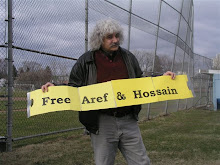


 Posts
Posts

